

Temporary vs. Permanent Mortgage Rate Buydowns: What Homebuyers Should Know
Temporary vs. Permanent Mortgage Rate Buydowns: What Homebuyers Should Know
When you're buying your first home, you may hear someone say:
"The seller can buy down your rate."
That sounds great. But what does it actually mean?
There are two very different ways to buy down a mortgage rate: a temporary buydown and a permanent buydown.
Both can help reduce your housing costs, but they work differently. Understanding the difference can help you decide how to use a seller credit when negotiating the purchase of a home.
What Is a Temporary Buydown?
A temporary buydown reduces your mortgage payment for the first few years of the loan.
For this article, we'll assume the seller is paying for the temporary buydown.
One of the most common options is a 2-1 temporary buydown.
How a 2-1 Buydown Works
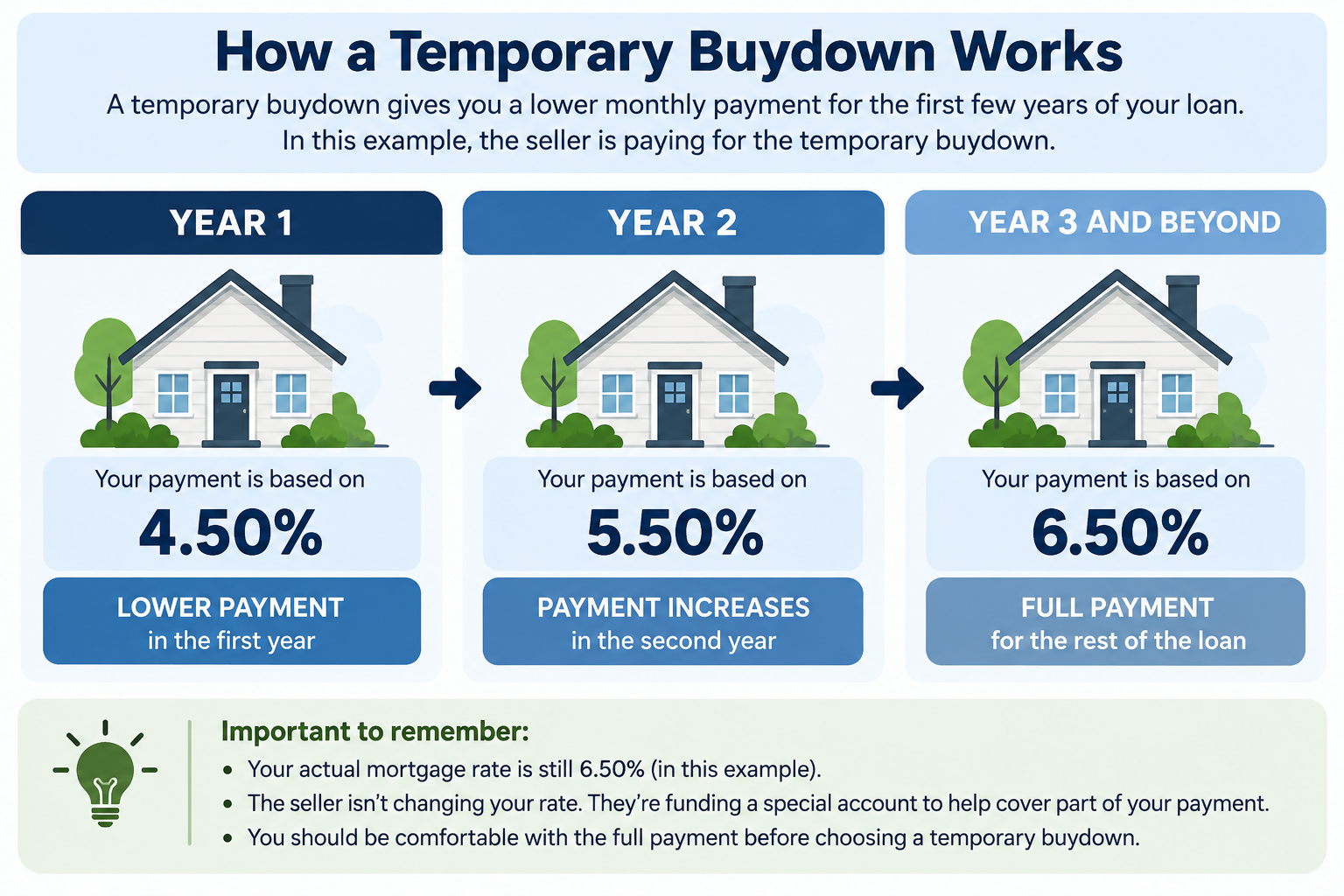
Let's say your actual mortgage rate is 6.50%.
With a 2-1 buydown, your payments would be calculated approximately like this:
Year 1: Payment based on 4.50%
Year 2: Payment based on 5.50%
Year 3 and beyond: Payment based on the full 6.50% note rate
Here's the important part:
Your actual mortgage rate is still 6.50%.
The seller isn't changing the interest rate on your loan. Instead, money from the seller is placed into a special buydown account at closing.
Each month, part of that money is used to make up the difference between your reduced payment and the full payment required by your loan.
Think of it as the seller helping with part of your mortgage payment during the first couple of years.
Why Would a Buyer Choose a Temporary Buydown?
The first few years of homeownership can be expensive.
You may be buying furniture, making repairs, adjusting to a new housing payment, or rebuilding your savings after paying your down payment and closing costs.
A temporary buydown can make that transition easier by lowering your initial monthly payment.
But there is something every buyer needs to understand:
You should be comfortable with the FULL payment before choosing a temporary buydown.
The lower payment doesn't last forever.
Depending on the loan program and type of temporary buydown, you may also need to qualify using the full payment rather than the temporarily reduced payment.
What Is a Permanent Buydown?
A permanent buydown works differently.
Instead of temporarily reducing your payment, money is paid upfront at closing to obtain a lower interest rate on the mortgage itself.
This is commonly called paying discount points.
Example of a Permanent Buydown
For example:
Rate without points: 6.50%
Rate after permanent buydown: 6.125%
If you obtain the 6.125% rate, that becomes your actual note rate. Your principal and interest payment is based on that lower rate for as long as you keep that mortgage.
Unlike the temporary buydown, there isn't a scheduled increase after one or two years.
The lower rate is permanent for the life of that loan.
Who Can Pay for a Permanent Buydown?
A permanent buydown does not necessarily have to be paid by the seller.
Depending on the loan program and transaction, discount points may be paid by the:
Buyer
Seller
Builder
Lender
Another eligible party
The rules depend on the loan program and who is providing the funds.
This is why it's important to review the entire financing structure instead of assuming a seller credit should automatically be used one particular way.
Temporary vs. Permanent Buydown: What's the Biggest Difference?
Here's the easiest way to remember it:
Temporary buydown = Lower payment now.
Permanent buydown = Lower interest rate for the life of that loan.
A temporary buydown may provide more payment relief during the first year or two.
A permanent buydown may provide smaller monthly savings, but those savings can continue for as long as you keep the mortgage.
Which Buydown Saves More Money?
There isn't one answer that works for every buyer.
Suppose you expect to keep the same mortgage for many years. Paying for a permanent rate reduction may provide more long-term value.
But suppose you think interest rates could fall and you may refinance within a few years. Spending a large amount of money to permanently reduce today's rate may not provide enough time to recover the upfront cost.
In that situation, a seller-funded temporary buydown could be worth considering.
Don't Forget About Your Other Closing Costs
There's another option buyers sometimes overlook.
Instead of using the entire seller credit for a rate buydown, you may be able to use some of the credit toward other eligible closing costs.
That could allow you to keep more of your own money in savings after closing.
The best choice depends on the numbers, your financial goals, and how long you expect to keep the mortgage.
How Much Can a Seller Contribute?
Mortgage programs limit how much assistance an interested party, such as a seller, can provide toward certain buyer costs.
The rules aren't the same for every type of mortgage.
Conventional Loans
For many Fannie Mae conventional loans on a primary residence or second home:
More than 90% LTV: Up to 3%
75.01% to 90% LTV: Up to 6%
75% LTV or less: Up to 9%
LTV means loan-to-value. In simple terms, it compares the size of your mortgage with the property's value.
For example, a first-time buyer putting 5% down would generally have an LTV above 90%, so the maximum financing concession would generally be 3%.
Different rules can apply to investment properties and certain loan programs.
FHA Loans
FHA generally allows interested parties to contribute up to 6% of the sales price toward eligible borrower costs.
That can include items such as closing costs, prepaid expenses, discount points, and qualifying interest-rate buydowns.
VA Loans
VA loans work differently.
VA generally limits what's specifically defined as seller concessions to 4% of the home's reasonable value, but not everything a seller pays is included in that 4% calculation.
For example, normal discount points and ordinary buyer closing costs generally are not counted toward VA's 4% seller-concession limit.
A seller-funded temporary buydown, however, is considered a seller concession and counts toward the 4% limit.
This distinction is important because saying, "VA only allows a 4% seller credit," can be misleading.
Does a Temporary Buydown Count Toward the Seller Concession Limit?
Generally, yes.
When the seller pays for a temporary buydown, the cost of the buydown is considered when calculating the applicable seller or interested-party contribution limits.
Here's a Simple Example
Let's assume:
Purchase price: $500,000
Applicable seller contribution limit: 3%
Maximum contribution: $15,000
Now suppose the seller agrees to provide the full $15,000.
If $8,000 is used to fund a temporary buydown, that $8,000 is part of the $15,000 available under the applicable concession limit.
It isn't an additional $8,000 on top of the $15,000.
The remaining $7,000 could potentially be applied toward other eligible closing costs, subject to the loan program's rules and the buyer's actual costs.
Does Real Estate Agent Compensation Count Toward the Concession Limit?
Real estate agent or broker compensation that is customarily paid as part of the real estate transaction is generally treated differently from a seller credit being given to the buyer for financing costs.
In other words, don't automatically assume that seller-paid real estate professional compensation reduces the amount available for a seller-funded temporary buydown or other financing concessions.
The exact treatment still needs to follow the requirements of the specific mortgage program and transaction.
Should You Ask for a Buydown or a Price Reduction?
This is where the math becomes important.
A $10,000 price reduction sounds significant, but it doesn't mean your mortgage payment drops by $10,000.
The reduction in your monthly payment may be relatively small because that $10,000 is spread across a 30-year mortgage.
Using that same $10,000 toward eligible closing costs or an interest-rate buydown could potentially have a much larger impact on your immediate cash needs or monthly payment.
That doesn't mean a seller credit is always better than a price reduction.
It means you should compare the options before negotiating.
Before You Make an Offer, Run the Numbers
If a seller is willing to provide a credit, don't decide how to use it based only on what sounds best.
Ask your mortgage professional to compare:
A temporary buydown
A permanent rate buydown
Using the credit toward closing costs
A price reduction
A combination of these strategies, when allowed
Then compare three important numbers:
How much cash will I need at closing?
What will my monthly payment be?
How long will it take before one option becomes better than another?
That's how you turn a seller credit into a financing strategy instead of simply negotiating a number.
The Bottom Line
A temporary buydown and a permanent buydown can both reduce your housing costs, but they solve different problems.
A temporary buydown can provide greater payment relief during the first few years of homeownership.
A permanent buydown can provide a lower mortgage rate for as long as you keep that loan.
Neither option is automatically better.
The better question is:
Which option gives you the most value based on your cash available today, your comfortable monthly payment, and how long you realistically expect to keep the mortgage?
Before you make an offer on a home, I can help you compare the numbers side by side so you and your real estate agent know which financing strategy makes the most sense.
You can book a call with me at www.loansbyamberjones.com/book-a-call, and we can start the process to help you discover which option is best for your situation.
Loan program guidelines, contribution limits, interest rates, and eligibility requirements are subject to change. The examples above are for educational purposes only and are not a commitment to lend or a quote of available interest rates.


