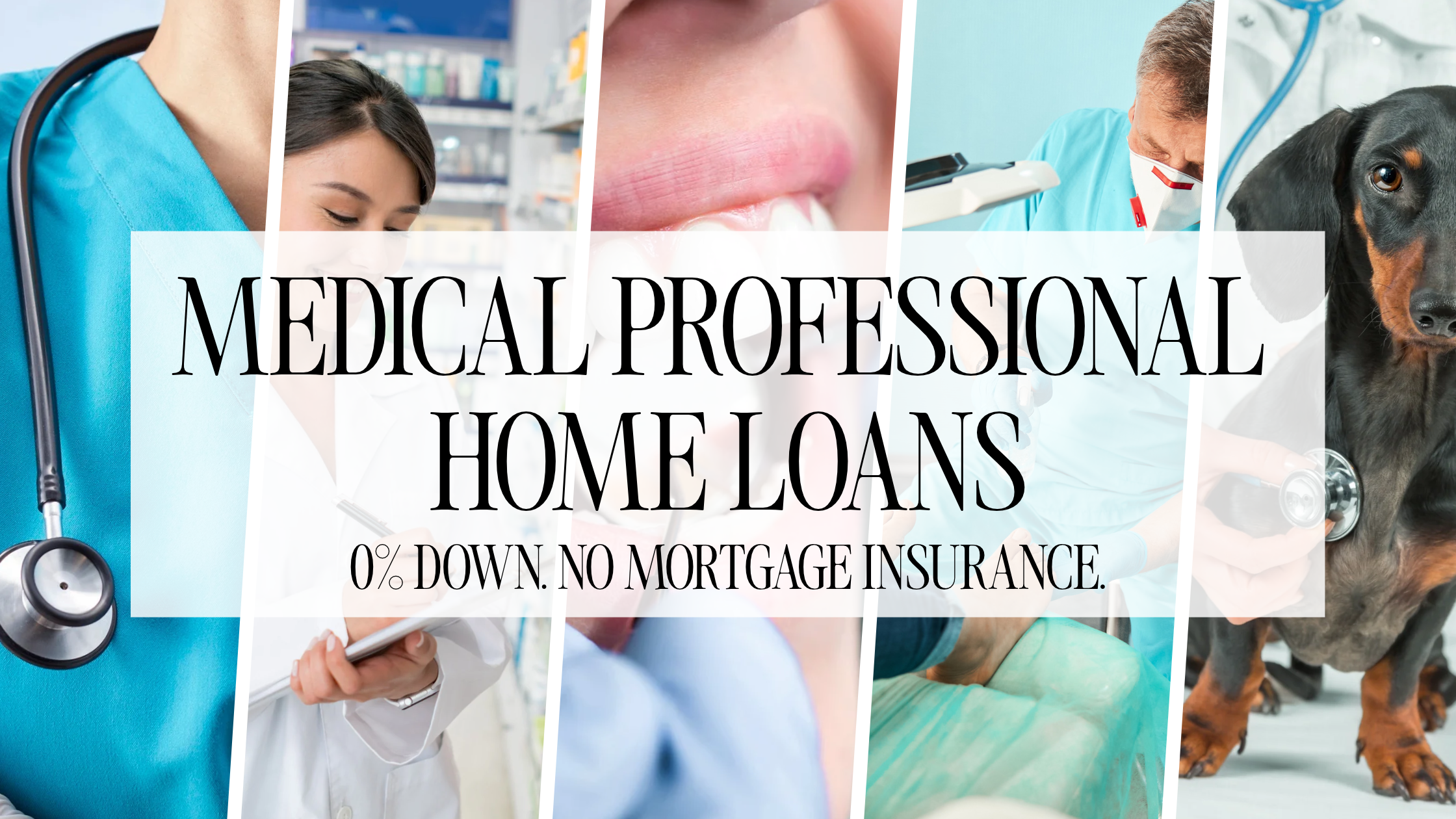
Medical Professional Home Loans: 0% Down, No PMI
Medical Professional Home Loans: Buy Your Home With 0% Down and No Mortgage Insurance
You spent a decade (or more) in classrooms, clinicals, residency and late-night charting. You have a strong income now, or a signed contract that says you will very soon. What you might not have is a big pile of cash sitting around for a 20% down payment, especially with student loans still in the picture.
Here's the good news: you don't need one.
A medical professional home loan (you'll also hear "doctor loan" or "physician mortgage") lets qualified healthcare professionals buy a home with up to 100% financing and no mortgage insurance. That means no down payment and no monthly PMI eating into your payment.
Let's break down how these loans work, who qualifies, and how to make sure you're getting the best version of one.
What Is a Medical Professional Home Loan?
It's a specialty mortgage built around the reality of a medical career: big earning potential, big student debt, and a timeline that doesn't always line up with a traditional lender's checklist.
On a regular conventional loan, putting less than 20% down almost always means paying private mortgage insurance (PMI). On a $900,000 home, that can easily add a few hundred dollars a month, for years, and it protects the lender, not you.
Medical professional programs skip that. Lenders know that doctors, dentists and other clinicians are among the lowest-risk borrowers out there, so they're willing to lend more with less down, without the PMI.
The Key Benefits at a Glance
Up to 100% financing (0% down) on loan amounts up to $1.5 million
Up to $2 million maximum loan amount (95% financing, or 100% with stronger credit)
No mortgage insurance, ever, even with nothing down
Minimum credit score of 680 on most programs
Fixed and adjustable options: 15, 20, 25 and 30-year fixed, plus 5/6, 7/6 and 10/6 ARMs
Gift funds allowed, including for reserves
Your co-borrower doesn't need to be in medicine. Only one borrower whose income is used to qualify needs the medical credential
Single-family homes, condos and townhomes (PUDs) are all eligible
Note: These programs are for your primary residence only, not second homes or rentals.
Who Qualifies? Eligible Medical Professions
This is where these loans have gotten a lot more generous in recent years. It's not just MDs anymore. Eligible designations include:
Medical Doctor (MD) and Doctor of Osteopathy (DO), including ophthalmology and psychiatry
Dentists: Doctor of Dental Surgery (DDS) and Doctor of Dental Medicine (DMD)
Doctor of Pharmacy (PharmD)
Doctor of Veterinary Medicine (DVM or VMD)
Doctor of Podiatric Medicine (DPM)
Certified Registered Nurse Anesthetist (CRNA) with a DNAP or DNP
Nurse Practitioner (NP) with an MSN or DNP
Medical residents, fellows and interns holding one of the degrees above
Select programs also include Physician Assistants (PA) and Doctors of Optometry (OD)
If you're a professor or medical director, you can qualify too, as long as your contract includes active clinical duties.
Residents, Fellows and New Grads: You Can Buy Before You Start
This is one of the most underused perks of a medical professional home loan.
If you've matched, signed with a practice, or accepted an attending position in a new city, you don't have to rent for a year to "build history." Many programs let you qualify using a signed employment contract or offer letter, with a start date up to 150 days after closing.
A few things to know:
The contract can only be contingent on things like getting your medical license or normal admin steps (background check, drug test, fingerprinting).
Housing allowances for residents and fellows can count as income on some programs, as long as it's paid directly to you and is guaranteed or shows on your paystubs.
Student loans in deferment, forbearance or a $0 income-based plan may be left out of your debt-to-income ratio for residents and fellows on certain programs. On others, your actual income-driven repayment amount can be used instead of a made-up "1% of the balance" payment.
That last one is huge. Student debt is the number one reason great medical borrowers get turned down at the big banks.
Flexibility You Won't Find on a Standard Loan
Beyond the down payment and PMI, these programs are designed around real-life medical careers:
Debt-to-income ratios up to 50% (at 95% financing or less) and 45% at 100% financing
Medical collections under $10,000 combined can stay open on some programs (because let's be honest, everyone in healthcare knows how medical billing works)
Self-employed or just bought into a practice? Some programs only need one year of tax returns, not two
Parents helping out? Certain programs allow a non-occupant co-borrower, which is perfect for the new resident whose family wants to help them qualify
What's the Catch?
Fair question. Here's the honest answer:
Rates can be a little higher than a conventional loan with 20% down. But once you factor in no PMI and keeping your cash in the bank, the total cost is often very competitive.
They're built for low down payments. Some programs actually require you to finance more than 90% of the price. If you're putting 20%+ down, a different loan may be a better fit (and I'll tell you if it is).
Escrow for taxes and insurance is usually required at higher financing levels.
Guidelines vary a lot from lender to lender. One lender's "no" can be another lender's "yes."
That last point is exactly why it matters who you work with.
Why Work With an Independent Mortgage Broker?
When you walk into a big bank, you get one doctor loan: theirs. If you don't fit their box, that's the end of the conversation.
As an independent mortgage broker, I'm approved with dozens of wholesale lenders, and several of them offer medical professional programs, each with their own rules. One may take a 680 credit score at 100% financing. Another may accept PAs and optometrists. Another may let you close months before your residency starts or ignore your deferred student loans.
I compare them side by side for your situation, then match you with the program that gets you the best terms. You get options, not a one-size-fits-all answer.
How to Get Started
Book a quick call. We'll talk through your credential, your timeline and where you want to buy.
Get pre-approved. I'll review your income (or contract), credit and student loans and match you with the right lender.
Shop with confidence. Make offers knowing exactly what you can afford with $0 down and no PMI.
Close and move in. Ideally before your first day on the new job.
Frequently Asked Questions
Can I really buy a home with 0% down as a doctor? Yes. Medical professional home loans offer up to 100% financing on loan amounts up to $1.5 million for qualified borrowers, with no mortgage insurance.
Do I have to be a physician to qualify? No. Dentists, pharmacists, veterinarians, podiatrists, CRNAs, nurse practitioners and (on select programs) PAs and optometrists can qualify, along with residents and fellows holding an eligible degree.
What credit score do I need? Most programs start at a 680 minimum score. Some require 720 or higher for 100% financing at the largest loan amounts.
Can I qualify before I start my new job? Often, yes. Many programs accept a signed employment contract with a start date up to 150 days after closing.
How are my student loans counted? It depends on the program. Some exclude deferred or $0 IBR payments for residents and fellows; others use your actual income-driven repayment amount.
Can I use this loan for a vacation home or rental? No. Medical professional home loans are for your primary residence only.
Does my spouse need to be in the medical field too? No. Only one borrower whose income is used to qualify needs the eligible medical credential.
Ready to Make Your Move?
You've put in the work. Your home loan should work for you, too.
If you're a doctor, dentist, NP, CRNA, pharmacist, vet or resident thinking about buying, let's talk. I'll show you what 0% down and no PMI looks like on a real home in your market.


