
Home Equity Loan vs. HELOC: Which Is Right for You?
Home Equity Loan vs. HELOC: Which Is Better for Paying Off High-Interest Debt?
If you bought or refinanced your home when mortgage rates were extremely low, you may be reluctant to touch that mortgage.
That makes sense.
But there’s another question worth asking:
How much is it costing you to protect your low mortgage rate while carrying high-interest credit card debt?
Many homeowners have spent the last few years waiting for interest rates to come back down. Meanwhile, credit card balances with double-digit interest rates continue to accrue interest month after month.
If you have equity in your home, you may have another option.
Instead of refinancing your entire first mortgage, you may be able to keep your existing mortgage in place and use a second mortgage to access some of your equity.
Two common options are a Home Equity Loan and a Home Equity Line of Credit (HELOC).
They both let you borrow against your home equity, but they work very differently.
What Is Home Equity?
Home equity is the difference between what your home is worth and what you currently owe against it.
For example:
Estimated home value: $700,000
Current mortgage balance: $400,000
Estimated equity: $300,000
This doesn’t necessarily mean you can borrow the entire $300,000.
How much equity you can access will depend on the loan program, your home's value, your existing mortgage balance, credit, income and other qualification requirements.
A Home Equity Loan or HELOC can allow you to access a portion of that equity without refinancing your existing first mortgage.
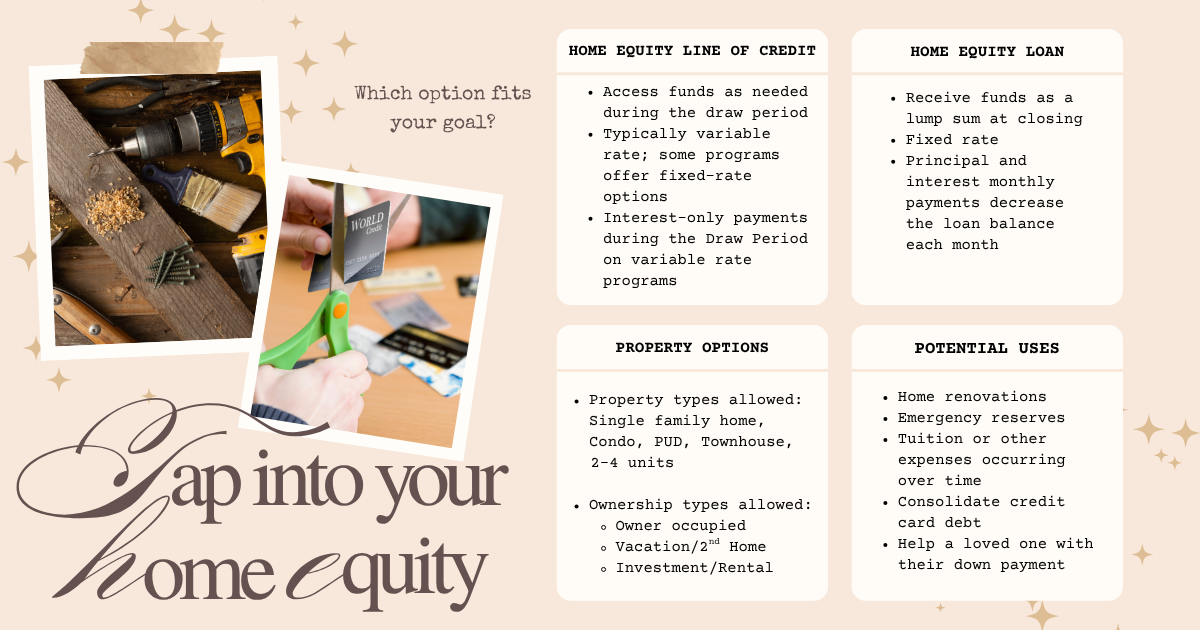
Home Equity Loan vs. HELOC: Both can provide access to your home equity without refinancing your existing first mortgage, but how you access and repay the money can be very different.
Home Equity Loan: Predictability
A Home Equity Loan can be a good option when you know how much money you need upfront.
You receive the funds as a lump sum at closing. The loan typically has a fixed interest rate with principal and interest payments designed to pay down the balance over a set loan term.
Here's an example:
Suppose you have:
$25,000 in credit card debt
$10,000 for another planned expense
Enough available home equity to qualify
You could potentially take a $35,000 Home Equity Loan and receive the money at closing.
Your existing first mortgage stays in place.
Why might a homeowner choose a Home Equity Loan?
The biggest advantage is predictability.
You know how much you're borrowing, the interest rate can be fixed, and you have a scheduled monthly payment.
For someone consolidating credit card debt, that structure can be especially helpful.
The goal isn't simply to move debt from one place to another.
The goal is to create a plan for getting the debt paid off.
HELOC: Flexibility
A Home Equity Line of Credit, or HELOC, works more like a revolving credit line secured by your home.
Instead of receiving all of the money upfront, you're approved for a credit limit.
During the draw period, you can typically borrow money, repay it and access the available credit again.
For example, you might be approved for a $75,000 HELOC but initially use only $25,000.
The remaining available credit could potentially be accessed later if needed.
Why might a homeowner choose a HELOC?
A HELOC can make sense when you don't know exactly how much money you'll need or when you'll need it.
For example:
Home renovations completed in stages
Emergency reserves
Tuition or other expenses occurring over time
Helping a loved one with a down payment
Projects where the final cost isn't known
That flexibility can be valuable, but it also comes with an important tradeoff.
HELOC Rates Can Change
Many HELOCs have variable interest rates, although some programs offer fixed-rate options.
Variable HELOC rates are generally based on an index plus the lender's margin.
This is important when the Federal Reserve is changing short-term interest rates.
The Federal Reserve does not directly set 30-year fixed mortgage rates.
However, many variable-rate HELOCs are tied to the Prime Rate, which generally moves when the Federal Reserve changes the federal funds rate.
That means a Fed rate increase can have a much more direct impact on a variable-rate HELOC than on a 30-year fixed mortgage.
If you're considering a HELOC, don't look only at the starting payment.
Make sure you understand whether the rate can change, how often it can adjust and what that could mean for your future payment.
Which Is Better for Credit Card Debt?
If the primary goal is paying off credit cards, don't automatically choose whichever option has the lowest starting rate.
I would look at the Home Equity Loan first and then compare it against the HELOC.
Why?
Because the problem we're trying to solve isn't simply the interest rate.
We're trying to get the debt paid off.
A fixed-rate Home Equity Loan can create structure:
One amount borrowed. One monthly payment. A defined repayment schedule.
A HELOC offers considerably more flexibility, but that flexibility isn't always an advantage when you're consolidating debt.
For example, imagine using $40,000 from a HELOC to pay off several credit cards.
You now have $0 balances on those cards and available credit on the HELOC.
If the credit cards gradually get charged back up, you haven't solved the original problem. You may end up with HELOC debt plus new credit card debt.
That's why the lowest starting rate isn't automatically the best financial decision.
The best option is the one that helps accomplish the actual goal.
But I Don't Want to Give Up My Low Mortgage Rate
You may not have to.
This is one of the biggest reasons a second mortgage can be worth considering.
Let's say you owe $400,000 on your current first mortgage at a low fixed interest rate and have $40,000 in high-interest credit card debt.
You could consider a cash-out refinance, but that would mean replacing your entire $400,000 first mortgage with a new mortgage at today's rate just to access the additional cash.
Depending on the numbers, that may not make financial sense.
A Home Equity Loan or HELOC could potentially allow you to leave the existing $400,000 first mortgage alone and borrow only the additional amount you need.
That's why I don't think the right question is simply:
"What's today's mortgage rate?"
A better question is:
"What's the most cost-effective way to manage all of my debt?"
Don't Compare the Monthly Payments Alone
This is where homeowners need to be careful.
Imagine replacing a credit card payment with a much smaller Home Equity Loan or HELOC payment.
It may feel like an immediate win.
But a lower monthly payment doesn't automatically mean you're saving money.
When comparing your options, look at:
Interest rate
Closing costs and fees
Monthly payment
Repayment period
Whether the rate is fixed or variable
Total interest over the time you expect to carry the debt
Your plan for keeping the credit cards paid off
Stretching short-term debt over a much longer period could lower your payment while keeping you in debt longer.
There's also an important risk to understand.
Credit cards are unsecured debt. A Home Equity Loan or HELOC is secured by your home.
If you fail to repay a loan secured by your home, your home could ultimately be at risk.
So this shouldn't be viewed simply as a way to get a lower payment.
It should be part of a larger debt-repayment strategy.
Home Equity Loan or HELOC: Which One Should You Choose?
Start with the purpose of the money, not just the interest rate.
A Home Equity Loan may make more sense if:
You know exactly how much you need.
You want a fixed interest rate.
You prefer a predictable monthly payment.
You're consolidating a specific amount of debt.
You want a structured repayment plan.
A HELOC may make more sense if:
You need access to money over time.
You aren't sure exactly how much you'll need.
You're completing a renovation in stages.
You want an available credit line for future expenses.
You're comfortable with the possibility of a changing interest rate and payment on a variable-rate program.
And sometimes neither option is the right answer.
That's why I recommend running the numbers before moving debt around.
Waiting for Rates to Come Down Has a Cost, Too
For the past several years, many homeowners have been saying:
"I'll deal with it when rates come down."
But if you've been carrying $20,000, $30,000, $50,000 or more in high-interest credit card debt while waiting, the interest hasn't been waiting with you.
Every month matters.
You don't necessarily have to give up the low rate on your first mortgage to address the rest of your debt.
And you don't have to guess whether a Home Equity Loan, HELOC or another option makes the most sense.
Let's Run the Numbers
If you're carrying high-interest debt and have equity in your home, let's compare the options before you make a decision.
I can help you look at your existing mortgage, current debts, available equity and potential financing options side-by-side.
We'll look beyond the advertised interest rate and compare the payment, costs, repayment structure and overall strategy so you can decide whether using your home equity actually improves your financial position.
Schedule a 15-minute call with me to review your options. You can book that call at www.loansbyamberjones.com/book-a-call.
This information is for educational purposes only. Loan availability, interest rates, terms, property eligibility and qualification requirements vary by borrower and loan program. Using home equity to consolidate unsecured debt converts that debt to debt secured by your home.


